v0= (16 m) / (2 s) - (1/2) (10 m/s2) (2 s)
and this reduces to v0 = 8 m/s - 10 m/s = -2 m/s. The answer is in proper units for velocity, and this increases our confidence that this answer is correct. Another way to identify possible errors in a numerical result involves estimating whether the magnitude of the answer is in the proper "ballpark," but this technique will be described and illustrated in Lesson 10.
EXAMPLE 1-1: Given that velocity (v) has units of length/time, that acceleration (a) has units of length/time2, and that distance (d) has units of length, evaluate whether or not the following equation is dimensionally consistent:
v2 = 2 ad2
Solution: Units of v2: (m/s)2 = m2/s2. Units of 2 ad2: (m/s2) (m)2 = m3/s2 . The units of v2 and 2 ad2 are not the same; therefore the equation is not dimensionally consistent and cannot be correct.
Practice Exercise 1-1 Write your solution to the following problems in your notebook.
1. Given that distance (d) has units of length, that acceleration (a) has units of length/time2, and that t represents time, determine whether or not the equation
d = 4at2 is dimensionally consistent.
2. Use the appropriate conversion factor to convert the given quantity to the units given in parentheses. (a) 2.2 × 101 atm; (dyne/cm2) (b) 9.6 × 10³ fm; (inches) (c) 6.5 m/s; (km/hr)
To see if you have achieved the objectives in Lesson 1, try working the problems in Self Check Test 1 without using any reference materials.
Self-Check Test 1
1. Given the equation
y = (v0 sin  )t -
(1/2)gt2, and [y] = m, [v0] = m/s,
[t]
= s, [g] = m/s2 determine whether or not the equation is dimensionally
consistent.
)t -
(1/2)gt2, and [y] = m, [v0] = m/s,
[t]
= s, [g] = m/s2 determine whether or not the equation is dimensionally
consistent.
Part 2: Rectilinear Motion
Keywords: Mechanics; Kinematics;
Supplement: How long does it take you to go home? This depends on how far you are from home (displacement), how fast (velocity) you can travel, and how often you must start and stop (acceleration). This lesson treats kinematics, which is the part of physics concerned with the description of the motion of a body. The body may be an automobile, a baseball, a raindrop, a flower in the wind, or a running horse. The change in position of a body can be described in terms of the quantities: displacement, velocity, and acceleration. Calculus can be used to define the relationships among these quantities. It is therefore essential to know some basic techniques of calculus to understand the content of this lesson. The applications in this lesson are limited to a treatment of motion in one dimension (i.e., rectilinear motion) but the fundamental concepts presented here are readily extended to motion in two or three dimensions. Remember that physics is an area of human knowledge based on accumulative learning and that the concepts of rectilinear motion are the foundation for the study of physics of moving bodies. Mastery of the material in this lesson is essential to a successful understanding and completion of subsequent lessons.
2-1: DISPLACEMENT, VELOCITY, AND ACCELERATION
Keywords: Displacement; Velocity; Acceleration; Translational Motion
OBJECTIVES: Distinguish between average and instantaneous values of velocity and acceleration, and distinguish between position and displacement and between velocity and speed.
PREREQUISITE: Distinguish proper equations based on the units (Lesson 1, Part 1).
Commentary
Rectilinear motion is the motion of a single particle along a straight line.
EXAMPLE 2-1: Write the mathematical definitions of displacement, instantaneous velocity, and instantaneous acceleration. Solution:
Displacement:  x = x2 - x1
where x2 is position at point 2 and x1 is position at point 1.
Average velocity: vavg= (x2 - x1)/(t2 - t1)
Instantaneous velocity: 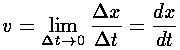 .
.
Instantaneous acceleration: 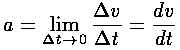 .
.
EXAMPLE 2-2: A woman swims the length of a 75-m pool and back again (one lap) in 60 s with a constant speed. (a) What is her displacement at the end of one lap? (b) What is her average velocity for one lap? (c) What is her average speed for one lap?
Solution: (a) x2 = x1; therefore,
x = 0. (b) Since x = 0,
vavg = 0. (c) speed = 150 m/60 s = 2.5 m/s.
Practice Exercise 2-1
1. An automobile travels on a straight road for 25 miles at 50 miles per hour. It then reverses direction and returns to the starting point at 75 miles per hour. (a) What is the average speed of the automobile during this 50-mile trip? (b) What is its average velocity?
2. The following table gives the position of a particle on the positive x-axis. See Table
| t (s) | x (cm) |
|---|---|
| 0.0 | 1.5 |
| 1.0 | 2.3 |
| 2.0 | 3.0 |
| 3.0 | 3.2 |
| 4.0 | 2.8 |
| 5.0 | 2.0 |
| 6.0 | 1.6 |
(a) What is the particle's displacement at t = 6 s? (b) What is its average velocity in the interval 1.0 to 3.0 s?
2-2: GRAPHICAL DETERMINATION
Keywords: Graphs; Mathematics; Slope; Displacement; Velocity; Acceleration; Translational Motion
OBJECTIVES: Given a graph of position as a function of time, for one-dimensional motion, determine either average or instantaneous velocity. Given a graph of velocity as a function of time, determine acceleration and displacement.
PREREQUISITE: Graphical interpretation of differentiation and integration (Calculus Review).
Commentary
One of the major advantages in the study of rectilinear motions is that complete information about a particle's motion can be displayed on a single, two-dimensional graph showing position on the vertical axis and time on the horizontal axis. Study the example in the text showing how this information may be extracted from the position/time graph and used to construct graphs of velocity and acceleration as a function of time. The following additional examples illustrate the same principles.
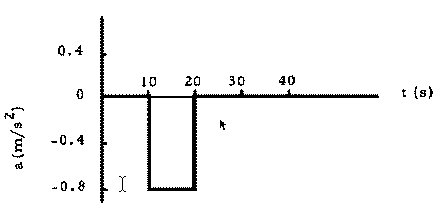
EXAMPLE 2-3: A particle's velocity is shown in the graph below. At t = 0, its displacement is x = 0. (a) Sketch the acceleration vs. time graph corresponding to this velocity vs. time graph. (b) Determine the average acceleration between t = 0 and 20 s. See Figure
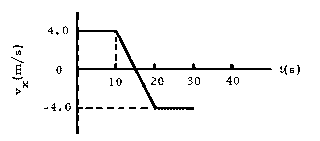
Solution: (a) Acceleration is the slope of the v vs. t graph. For the first 10 s the acceleration is zero (a = 0). The acceleration is also zero for t = 20 s. For the time between 10 s and 20 s the slope is constant and the acceleration is therefore also constant and equal to
a = aavg =
v/t =
(v2 - v1) / (t2 - t1)
= [(-4.0) - (4.0) m/s] / 10 s = -0.80 m/s2.
The graph of the particle's acceleration is shown below. See Figure
(b) aavg = (v2 - v1) / (t2 - t1) = [-4 - (+4) m/s] / 20 s = -8 m/s / 20 s = -0.4 m/s2.
EXAMPLE 2-4: Sketch the graph of position (x) vs. time (t) corresponding to the velocity vs. time graph in Example 2-3.Solution: At t = 0, x = 0. The position at any time is the area under the v vs. t graph up to that time. At t = 5 s; x = 4 m/s × 5 s = 20 m. At t = 10 s; x = 4 m/s × 10 s = 40 m. At t = 15 s; x = 40 m + (1/2)4 m/s × 5 s = 50 m. At t = 20 s; x = 50 m + (1/2) (-4) m/s × 5 s = 40 m. At t = 30 s; x = 40 m + (-4) m/s × 10 s = 0. See Figure
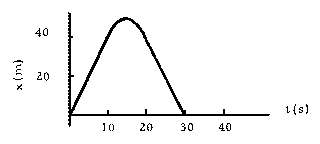
(Note: The graph is not linear between t = 10 and 20 s. In fact, it is a parabola, which will be shown later.)
Practice Exercise 2-2
The given figure shows the velocity vs. time graph of a particle's motion. See Figure
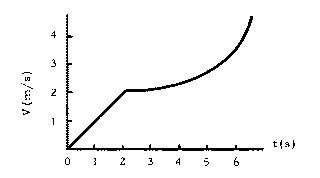
1. During what time interval is the particle traveling with constant acceleration?
2. Calculate graphically the displacement of the particle during the first 3 s.
3. Estimate the particle's acceleration at t = 5 s.
2-3: ANALYTICAL DETERMINATION
Keywords: Displacement; Velocity; Acceleration; Translational Motion;
OBJECTIVES: Given a mathematical expression for position as a function of time, for one-dimensional motion, determine an equation for velocity as a function of time. Given a mathematical expression for velocity as a function of time, determine the equations for acceleration and displacement as a function of time.
PREREQUISITE: Differentiate and integrate simple polynomial functions and sine and cosine functions (Calculus Review).
In Section 2-1 of this lesson, you learned the mathematical definitions of instantaneous velocity and acceleration. Both of these definitions involved derivatives with respect to time. Thus, if the displacement of a particle can be described by a simple mathematical function of t, then the velocity and acceleration can be determined analytically by successively differentiating the displacement function. Conversely, if acceleration is known as a function of time, the velocity may be found by integration. Displacement as a function of time can likewise be determined by integration of the velocity function. It is essential that you carefully study Example 2-5 in this section and do the practice exercises, because the text's discussion of analytical determination is limited to examples involving constant acceleration. To achieve the objectives for this section, you will need to be able to differentiate and/or integrate simple functions. Refer to the Calculus Review or a basic calculus text to review mathematical concepts as necessary.
EXAMPLE 2-5: The vertical position of a body under constant acceleration is given by
y = y0 + v0t + (1/2) at2
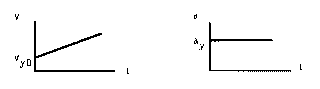
where: t = time, y = vertical position at time t, v0 = initial velocity in vertical direction, a = acceleration in vertical direction, y0 = initial position. By the use of calculus, find the velocity and acceleration of the body as a function of time. Also construct a graph of velocity vs. time and acceleration vs. time for this case.
Solution: v = dy/dt = d/dt(y0 + v0t + (1/2) at2) = v0 + at
a = dv/dt = d/dt (v0 + at) = a.
See Figure
Practice Exercise 2-3
1. A particle moves along the x-axis in such a way that its x coordinate is given by
x = 3 + 20t - t2,
where x is in meters and t is in seconds. Find the following. (a) The particle's velocity at t = 4 s (b) The particle's position at t = 4 s (c) The particle's acceleration at t = 4 s
2. Let v = A cos wt where A and w are constants and v is the velocity of a particle along the x-axis. Find the expressions for (a) acceleration as a function of time (b) position as a function of time.
2-4: CONSTANT ACCELERATION
Keywords: Displacement; Velocity; Acceleration; Uniform Motion; Translation Motion; Learning Objectives
OBJECTIVE: Given a case involving one-dimensional motion of a body with constant acceleration (e.g., a body falling freely near the surface of the earth), determine the displacement, velocity, and/or acceleration of the body.
Commentary
The rectilinear motion of a body experiencing constant acceleration is completely specified if the initial conditions of the motion (initial velocity v0 and initial position x0) are given along with the acceleration, or can be determined from other given information. Make sure that you understand the origin of the equations summarized as (3-17) in the text and that you can apply these equations to solve problems. For a body moving vertically in a uniform gravitational field, it is usual to describe position in terms of the y-coordinate and to equate the acceleration a with -g, to indicate that it acts in the negative y-direction. These are arbitrary conventions, however; the more important consideration is defining the coordinate axes so that the solution of the problem is simplified. The following example problem involving constant acceleration is included to supplement those presented in the text.
EXAMPLE 2-6: An object is thrown vertically upward in a uniform gravitational field that produces an acceleration of a = -g = -9.8 m/s2. It has a speed of 9.8 m/s when it has reached one-half its maximum height. (a) How high does it rise? (b) What is its speed 1 s after it is thrown? (c) What is its acceleration when it reaches its maximum height?
Solution: (a) This problem requires the solution of the following equation:
v2 - v02 = 2ay
(constant acceleration). Since v = 0 at y = ymax, this equation yields v02 in terms of ymax and -g:
-v02 = -2gymax
Substituting for -v02 in the original equation gives:
v2 - 2gymax = -2gy
v is known when y = (ymax)/2; at this point,
v2 - 2gymax= -2gymax/2
v2=gymax
v2/g=ymax
Thus ymax = v2/g = (9.8 m/s)2/(9.8 m/s2); thus ymax = 9.8 m
Also: v02 = 2gymax = 2(9.8 m/s)2
So v0 = 13.9 m/s. (b) v - v0 = at; v = v0 - gt = 13.9-9.8 = 4.1 m/s. (c) a = -9.8 m/s2 (acceleration is constant).
Practice Exercise 2-4: A rocket is fired vertically and ascends with a constant vertical acceleration of +20 m/s2 for 80 s. Its fuel is then all used, and it continues upward with an acceleration of -9.8 m/s2. Air resistance can be neglected.
1. What is its altitude 80 s after launching?
2. How long does it take to reach its maximum altitude?
3. What is this maximum altitude?
Self-Check Test 2
1. Write the mathematical definitions of displacement, instantaneous velocity, and acceleration. See Figure
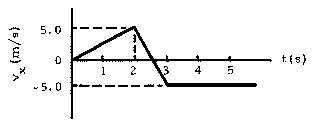
2. A particle's velocity is shown on the graph. At t = 0, the displacement is x = 0. (a) Sketch the displacement and acceleration as a function of the time. (b) Determine the average acceleration during the time interval t = 0 to 2.5 s.
3. The position of a particle as a function of time is given by y = at3 - b t, where a and b are constants. Find the expression for velocity as a function of time.
4. A ball is thrown vertically upward from the ground with an initial speed of 24.5 m/s, under the influence of gravity (g = 9.8 m/s2). (a) How long does the ball take to reach its highest point? (b) How high does the ball rise? (c) What are its velocity and acceleration at its maximum height?